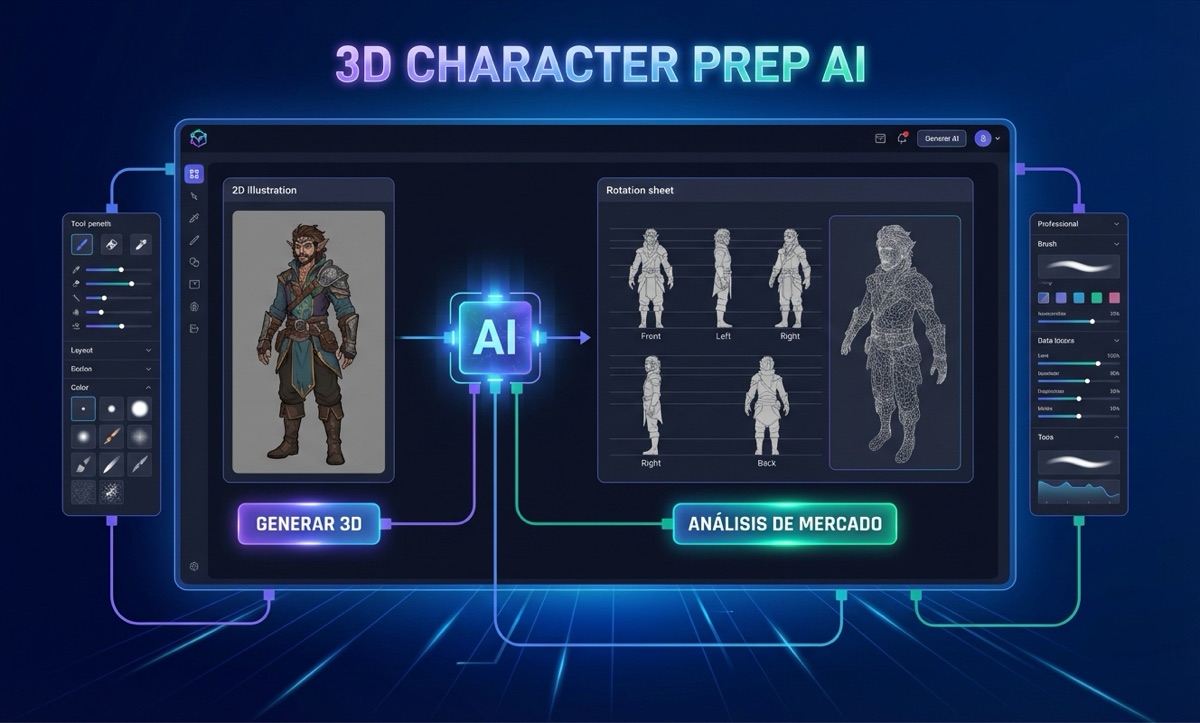
3D Character Prep AI
An AI tool for digital artists and 3D modelers. Turns 2D illustrations into technical turnaround sheets with consistent views (front, left, right, back) and a 3D mesh preview, speeding up the digital sculpting workflow.
What is it?
An AI-powered web tool for those of us who sculpt and sell 3D characters (figures, action figures, miniatures). You upload a 2D illustration and it generates a turnaround sheet with consistent views —front, left, right and back— and a preview 3D mesh so you can start sculpting from a solid reference. Over time it has become the studio's full workshop: catalogue shots, bundle composition, marketing copy, Cults3D market analysis and an STL splitter to print figures in parts.
Why I built it
I model and print figures myself, and the slowest step isn't sculpting: it's preparing the reference. A single illustration doesn't give you consistent orthographic views, and without them you end up making up half the character. I wanted to automate that "prep" with generative AI so I'd arrive in Blender with the homework done. Then I kept adding every repetitive task involved in selling figures, all the way to cutting parts for the resin printer.
How it works
Character Prep
- Upload the image (HEIC works too) and describe the character; you can keep the original pose, switch to a neutral A-pose or describe your own, and choose whether to preserve the face style or normalise it.
- A neutral view is generated and, from it, the turnaround sheet. You can edit the description, regenerate the whole sheet or a single view, and even generate a rotation video with Veo.
- The sheet is sent to an asynchronous Hunyuan 3D job; the result is previewed in the browser and downloaded as OBJ or GLB.
Studio workshop
- Figure Finisher: catalogue shots with white, neon-smoke, matching-colour or themed backgrounds; virtual painting from a reference; logo and format adjusted for each network.
- Bundle Prep: multi-figure scenes, either free composition or based on a reference, specifying each figure's height.
- Character Creator: original characters from a text prompt, with automatic prompt enhancement.
- Marketing Assistant: identifies the character and its universe and writes the copy for Instagram, Cults3D (title, description, print settings, tags), Wallapop and the monthly Patreon drop, tuning season, listing type and tone; it also generates the Patreon post banner with your logo.
- Market Insights and Studio Analytics: trends and competitors on Cults3D, plus the evolution of downloads and revenue for your models.
STL Splitter
Everything runs in the browser: load an STL (parsing and the BVH run in a Web Worker), paint up to 16 "islands" with a brush or a smart bucket, cut with a clean plane or along the painted outline, place alignment connectors (pin, tapered, pyramid) and export each part as STL. The mesh logic is verified with headless scripts (watertightness, volume conservation).
Stack
| Layer | Technology |
|---|---|
| Frontend | React 19 + TypeScript + Tailwind, built with Vite |
| AI | Gemini 3 (text and image) and Veo through a proxy on Supabase Edge Functions; Tencent Hunyuan 3D |
| 3D in the browser | model-viewer for previews; three.js, three-mesh-bvh, manifold-3d and earcut for the splitter |
| Backend | Supabase: Edge Functions (Gemini and Cults3D proxies, stats collector) and Postgres with a daily cron |
| Deployment | Vercel with CI/CD from main; MIT license |
Status
Active and evolving. I use it in my own studio, and the splitter is the part growing fastest. Next steps:
- Improve view consistency on highly detailed characters.
- Move the API keys fully to the backend.
- Document the complete flow from illustration to printed figure.